Sunday, June 9, 2013

The little girl that wanted to be a kid again :)


G’day G’day,

So after ortho comes plastics. And just like ortho, you have those plastics patients that capture your heart. For me Jaka is one such little girl...


Here is her story captured by our talented writer Catherine Murphy…


There is a universal principle of childhood physics that we all remember well: the joy of spinning in circles. Perhaps it was spinning while locking hands with a playmate, in a teacup at Disney World, dancing in pirouettes, or simply turning in place – it was a thrill to send our surroundings into a kaleidoscopic blur. This was followed by a dizzy fit of giggles – at least until our internal compasses caught up, and the world came back into focus. Do you remember?
 

Four years ago, a little girl named Jaka was spinning around in circles with some other children while her mother was at the market. Around and around, arms out, chin up, her face full of smiles. Tragically, when Jaka lost her balance, she plummeted into her aunt’s cooking fire. Jaka landed in the burning coals on her left side with her arm up. The pot of boiling water her aunt had prepared for rice spilled over the little girl’s shoulders, arms and back. 


Fanta, Jaka’s mother, ran home from the market and took her daughter to a local hospital in Conakry. In order to be seen by doctors, the hospital required a payment of 1.5 million Guinea Francs at the gate – just over $200. The family could not afford admission.  Fanta returned home with Jaka, unable to ease her daughter’s agony. For the next eight months, Jaka laid on her little stomach, tethered to the ground by unimaginable pain. Each day, her mother fanned her, trying to offer Jaka whatever relief she could from the inescapable African heat. 

As Jaka’s burns healed without medical care or rehabilitation, her left shoulder and arm contracted. Jaka’s skin began to grow back in such a way that her arm became stuck to her side from her armpit to elbow. Fanta feared that Jaka would lose the ability to move her arm. Still unable to afford any medical treatment, Fanta tried to treat the problem herself.
Fanta forced Jaka’s arm away from her side three times, trying to prevent the contracture. Fanta described each attempt, saying that she and Jaka both cried themselves to exhaustion. On the fourth try, Jaka begged her mother to stop because the pain was so unbearable. “If you try to pull it open again, I will die. The pain will kill me,” Jaka said to her mother. With that, Fanta resigned herself to allowing Jaka’s arm to heal on its own, stuck to her side.

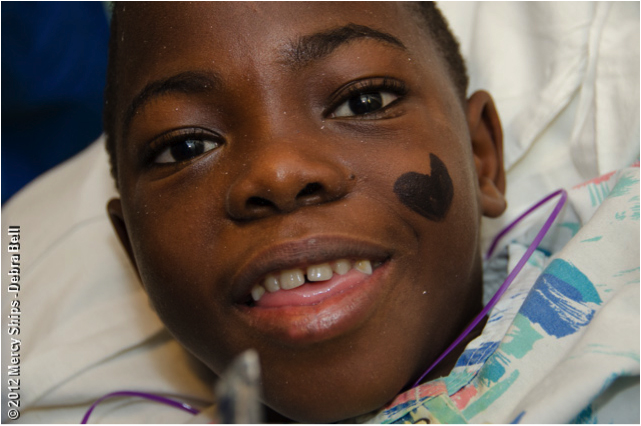
Today, 9-year-old Jaka is a patient on the Africa Mercy hospital ship, recovering from a free plastic surgery that released her arm and grafted skin. Deep burn marks cover her entire upper body – her head, neck, shoulders, back and arms – but no one notices because they are entranced by the little girl’s adorable gap-toothed smile.


Dr. Guido Kohler (Germany) and OR Nurse Allison Green (Texas) operate to release Jaka’s burn contracture.

Sweeping, washing and fighting – these are the activities Jaka says she will get to do with her restored arm. Laundry might not be appealing to many, but participating in household chores is a normalcy Jaka has never known. “I am so happy,” Jaka says. “When I go home, I will work all the time because I can.” (Fanta admits she is glad for this enthusiasm.) Free of her deformity, Jaka will also now be able to go to school for the first time.


As for fighting, Jaka is one of ten children, and she happens to be very ticklish. With her new arm, she will be able to hold her own the next time she is picked on by one of her older brothers or sisters. She was ashamed to go among her siblings and friends when her arm was stuck to her side because they would tease her. “Now they will see me and say, ‘Jaka has become well!’” she declares. Then they will invite her to sit with them and watch the cars go by their house.


From her hospital bed, Jaka is all giggles – she can hardly contain her excitement for her now-bright future of playing, going to school and watching cars. But Jaka’s favorite part about her restorative surgery and rehabilitation is even simpler than that: “Clapping!” she exclaims. With her arm free, Jaka can finally clap with both hands.

The thing Jaka is most excited about? Her ability to clap

Now there’s a happy ending worthy of applause.

Written by Catherine Clarke Murphy


Jaka really does have a joy and whenever she comes down to the tent the whole atmosphere changes. Her smile and laughter make all the hard work worth it. Jaka really has reminded me to always be thankful for the small things.

God is Good
and He reminds me daily :)


Friday, May 17, 2013

A Thank you letter :)


Hey Team,  

You know I was praying the other day and asked God to remind me of why I am here in Africa and then I heard about Fannie's  thank you letter.  If you want to check out his story check my blog entry back in 2011 on him. 

http://nickveltjens.blogspot.com/2011/10/life-that-i-love.html

He really was a little kid that stole my heart away. 


Here is the update from Fannie about two years after meeting the Mercy Ships team:


Twelve-year-old Fanie came to the Africa Mercy  in Sierra Leone in 2011.   His deformed legs prevented him from walking.

In spite of relentless mocking, he had a joyful spirit and a contagious smile that captivated the hearts of the Mercy Ships crew.  He maintained his joy throughout a series of complex surgeries and a long recovery time.


Recently, he sent the following thank-you letter to Mercy Ships:
Is me Fanie from Sierra Leone, Koinadugu  District, Kabala.
I will first say thank you for the wonderful things you and the entire term of Mercy Ships done to me. You operated on me sometime 2011 in the ship wherein I was unable to work with my feets. But presently I am attending my primary School in Kabala and I am in class 4. I usually thanks you everyday for the wonders you does. I will try to send the picture of me with my uniform. Presently, I am among human being. At first I was looking as an evil being.
May God bless you and your entire family at home.
Thank you,
With love, Fanie


Praise God for He is good.


Monday, April 22, 2013

That cute little kid that always ran through our door (uninvited)...


G'day G'day,

The end of the outreach is always bitter sweet. You know you are about to leave soon but you also start finding out the difference you have helped to make.


Little Sakoba is definitely someone who stands out so here is his story written by our writers on the ship...


By the time he was three years old, Sakoba had developed severely bowed legs. A naturally happy and energetic boy, Sakoba adapted well, finding his own gait to keep mobile.


His mother, Kadiatou, often struggled to keep up with Sakoba, due to her own painful hindrance – Kadiatou was also born with legs that bowed deeply in her early years.


Kadiatou and her husband, Mouctar, prayed for healing for Sakoba. Then, according to Kadiatou, something miraculous occurred. “Our neighbor told us that a big hospital ship was examining people in Conakry the very next day. He said that they might be able to help Sakoba.” Kadiatou hastily bundled up Sakoba and one-year old Ibrahim. They arrived at the  Mercy Ships screening site just in time. Sakoba was one of the last children, out of hundreds, examined for possible orthopedic surgery. When Sakoba was given an appointment for surgery onboard the Africa Mercy hospital ship, Kadiatou was thankful to God that her son would have straight legs.

Kadiatou and Ibrahim accompanied Sakoba to the Africa Mercy hospital ship. Mouctar, who suffered from leprosy, stayed home because he did not think he would be allowed onboard the ship. While Sakoba recovered from his successful surgery, Kadiatou basked in the loving environment of the hospital ward. She confided to Marie, a Mercy Ships volunteer, “I am cursed with bad legs, and Mouctar, my husband, is cursed with leprosy. Because we are cursed and useless, our children will have lives of suffering too.” This was not the first time that Marie had heard about the deep fatalistic beliefs that could strangle entire communities.

But Kadiatou’s cloak of sadness lifted as she found unexpected solace in the kindness showered on her, Ibrahim and Sakoba.


She recalls, “For the first time, I felt that Sakoba and I were accepted and included. We did not feel like cripples and outcasts.” When they returned home from the hospital, Kadiatou gave her husband some more good news, saying, “Mouctar, we were wrong to believe that you could not come with us to Mercy Ships. Your leprosy is being treated, and so, as Sakoba’s father, you are more than welcome to come to his appointments.”


Mouctar and Kadiatou were surprised to learn that Mouctar was not an outcast as far as Mercy Ships was concerned. Leprosy struck Mouctar in his youth, but the disease has been halted and is managed with medications through a local clinic. Mouctar was more than welcome to accompany his son to his post-surgery appointments. 


When the family, now including Mouctar, arrived for Sakoba’s follow-up appointment, Marie was there to greet them. Marie started to chat, asking warmly, “How did Sakoba do at home? What business are you in, Mouctar? Isn’t it wonderful that there is now treatment for leprosy? What plans do you have for the family now that Sakoba has straight legs?” 

Kadiatou is delighted that Sakoba’s legs are straight and strong.


Mouctar gazed intently at Marie and replied. “You are speaking to me like I am a human being. You make me believe that I am worth something and that I can give my family a better future.” Mouctar then took a deep breath, and, holding his wife’s hand, he continued. “People tell us that all we are good for is begging. They tell us to give up hope that we can support ourselves. Kadiatou has a good piece of land that she inherited from her mother. People tell us to sell the land because beggars will never have use for land. Before we came to Mercy Ships, I almost believed that. I almost gave up hope and sold that land. But now? Mercy Ships not only healed our Sakoba, but every person here gave us love and respect. You gave us reason to have hope.”


Kadiatou found solace in the kindness showered on her and Sakoba during their stay in the Africa Mercy hospital ship. Kadiatou loved how she and Sakoba were accepted and included, rather than being treated like outcasts. Volunteer Laura Zuilkowski was one of Sakoba’s favorite friends.

Mouctar and Kadiatou are determined to build a self-sufficient future for their family – to turn hope into action. With a small hand up from new Mercy Ships friends, plans are underway to build a modest dwelling for the family on their land. Mouctar is also re-activating his plan to expand his phone card business into selling a full range of telephone accessories. Kadiatou foresees a small business for herself selling foodstuffs like rice, tomato sauce and oil. But, as Kadiatou notes, “That is further down the road. Right now, I have Sakoba with his straight and very strong legs to keep up with and Mouctar, who needs help with all of his activities.”


Written by Joanne Thibault


I will always remember Sakoba as the little kid that always always always ran through our door (uninvited) and greeted us with a warm hug. With his little brother never too far behind. It would never matter how busy we were, he would always run through and dodge everything that was going on and make his way straight to you and give you a hug. I never complained because he is the cutest little kid ever with his little brother not too far behind. His hugs, joy and smile often reminded me of how much God loves us.

Sakoba and his little brother


So what's next,

Trying to get everything done before we leave :)

God is Good and His love endures forever... 


Friday, March 8, 2013

God's Love in Action


G'day Team,

I just wanted to share a story with you about God coming into the life of a little boy called Yaya.


 Our writers on the ship did a great job capturing his amazing story so here it is...

Yaya Relies on a Grandmother’s Love
 
Rather than joyous celebration, the reaction to Yaya’s birth was broken family ties. Yaya’s mother, Salematou, and his father, Abdulaye, were not married when their son was born. The tradition that Salematou’s father lived by did not make room for a child born out of wedlock. Despite Salematou’s pleading with her father to allow her to keep her child, his decision was final. As soon as Yaya could leave his mother’s breast, he was sent to live with Kadiatou, his grandmother on his father’s side. 


Living with his grandmother turned out to be a wonderful blessing for Yaya. Kadiatou personifies the bottomless heart and limitless space that African grandmothers offer their children and their children’s children. She assumes whatever responsibility comes her way, no matter the burden. Kadiatou explains, “There are many mouths that I feed in my family. In addition to Yaya, five of my children and their nine children need my support too. Everyone shares in the work of the household, but earning income in Conakry is very difficult. My husband now, Mamadouba, is very old. He gives what money he can, but he has family to support too.” 


Yaya is blessed with a grandmother who is devoted to his well-being and healing. Kadiatou and her eldest son, also named Yaya, talk with volunteer Hospital Chaplain Clementine Tengue about the sometimes challenging journey to healing that brought Yaya to Mercy Ships.

Yaya stole his grandmother’s heart from day one. His ready smile and eagerness to be close to her formed a thick bond. When tragedy struck Yaya, Kadiatou was distraught. “Yaya started walking when he was one year old, but after taking a few steps he would fall. We tried many traditional medicines, but his condition grew worse. At eighteen months, his legs started to twist and curl up. They failed him entirely.” 


Yaya was born with a condition that caused his bones to be very brittle. When Yaya started to walk, the pressure on the bones in his legs caused multiple fractures. As a result, Yaya’s legs twisted and curled. By eighteen months of age, he was unable to walk at all.

Yaya’s uncle, also named Yaya, remembers this as a time of many trials for his mother.  “Kadiatou was so afraid for Yaya. He often had a high fever, and his legs would cramp up terribly. He would cry for hours from the pain. Kadiatou tried everything to soothe him. She held him for hours. Then my father and sister died very close together. My mother’s heart was broken into so many pieces.” 


Kadiatou, who had taken in her daughter’s five children, decided that moving the family to Conakry, the capital of Guinea, was best for Yaya. “I hoped that the medical care Yaya needed was in a big city. As well, I knew that Conakry had schools for handicapped children that Yaya could attend.” Another important reason for the move was that Kadiatou was protecting Yaya from the villagers who thought that children with disabilities were cursed. She would not stand for her grandson being tormented, ridiculed, or forced into hiding. 


When Yaya reached five years of age, he started attending the school for handicapped children. “I was so happy for Yaya. He started to learn his letters and bring home things he made,” Kadiatou says. Although there were no school fees and transportation was provided, Kadiatou still had expenses to cover, like school supplies. She made ends meet by going to the Grand Mosque daily and helping with cleaning and cooking. After a full year of being a volunteer, she was finally included in the group that received a weekly stipend, plus donations of money and food from appreciative people attending the Mosque. 

Yaya often joined Kadiatou at the Mosque after school, and he soon became a favorite with everyone. In the Muslim faith, people are eager to help the needy as a way of observing sadaqah, the duty to overcome miserliness. Many Muslims wanted Yaya to join the group of handicapped people who begged, so that people could give to him. Kadiatou was against Yaya’s doing this, regardless of the enormous struggle she had to support the family. “I faced so much pressure to allow Yaya, in such obvious need, to help people fulfill their duty to sadaqah. I finally relented,” she explains.


Kadiatou continued to be distressed with Yaya’s participating in sadaqah. She prayed that Yaya would get his education and find an occupation where he could use his sharp mind and very able hands. Kadiatou had many doubts about her prayer being answered, but she remained faithful, clutching that thin bit of hope to her heart. 


Yaya himself dared not hope. But then an incredible set of circumstances unfolded around him. Nick Veltjens, who worked with orthopedic patients, saw Yaya at the patient screening location the day before consultations began. “I waited all screening day for Yaya to come because I thought we could help him. We didn’t see him that day, so I sent an email around asking if anyone knew where he was.” 


According to Yaya, “I did go to the screening with my friend, but I lost my courage.” Yaya left without being examined. 

The next day, Dan Bergman, a long-term hospital volunteer, came to Nick with a video of a possible orthopedic patient that he had just seen outside the Mercy Ships Dental Clinic. According to Nick, “What a coincidence that Dan found the same little guy that I was looking for!” 

For Dan, this series of events said loud and clear that, “God wanted Yaya to find Mercy Ships. He kept putting him in front of us!” Dan tracked Yaya down at the Mosque and delivered the news that he had an appointment at the hospital ship. 

But Yaya missed his appointment. As he says, “I did not believe I could be healed, and so I did not want to tell my grandmother to bring me. She would be too disappointed.” But another divine coincidence occurred that finally put Yaya and Mercy Ships together. A government official, Cellou, who had befriended Yaya at the Mosque, was at the Mercy Ships Dental Clinic that same week. He casually asked what a young boy with deformed legs needed to do to get an appointment. It was quickly realized that the boy in question was Yaya and that he just needed someone to bring him to his appointment. 


Cellou immediately went to Yaya’s grandmother with the news about Yaya’s appointment. They agreed that Cellou would go to the hospital ship with the boy. When Kadiatou received the telephone call from Cellou telling her that Yaya was accepted for surgery, she experienced a mixture of emotions. “I was so grateful that Yaya could be helped. It was all that I had prayed for. But I was also very uncertain and afraid. I wondered how it would be possible to fix Yaya’s legs and what he would go through.” 

Dr. Frank Haydon, volunteer orthopedic surgeon, was able to fix Yaya’s legs. According to Dr. Frank, “The condition that Yaya was born with caused his bones to be very brittle. As he started to walk, the pressure on the bones caused multiple fractures. The surgery he had aligned his leg bones properly, and the two rods I installed will give his legs the needed strength and structure so he can walk.”  


Yaya’s warm heart and precocious nature have earned him many friends in the Mercy Ships hospital. The kind hearts embracing Yaya have encouraged him to practice his reading, his exercises and to learn some English.

Each day Yaya does grow stronger. He is starting to take his own steps with the help of a walker, and he has progressed to simple below-the-knee leg casts. But at the same time, each day wears on Kadiatou. She shows the strain of being away from family and being indebted to more and more neighbors. She has borrowed money from them for food and malaria medication. However, regardless of the hardship, Kadiatou’s commitment to see Yaya through his healing journey is unwavering. “I would endure anything so Yaya can do what he longs to do more than anything else – play football. By suffering for Yaya and my family now, I know that there will be great happiness in the future,” she says.


Immediately following surgery, Yaya was given a body cast to support his newly aligned bones as they strengthened around the rods placed to provide permanent support. Yaya displayed much courage and bravery throughout his surgery and the regular physiotherapy sessions. His grandmother was always at his side to comfort and encourage him.


When Yaya’s body cast was replaced with leg casts, he was able to see his now straight legs for the first time. While Yaya, at first, did not dare to hope that he could be healed, he is now full of hope to play football and return to school to learn to read and write.

According to his uncle, Yaya’s journey to hope and healing is summed up in a few words: “Yaya is so loved by everyone on Mercy Ships.” And, still, even with so many kind hearts embracing Yaya, there is one who continues to occupy the most special place in his heart. As clear as a bell, Yaya declares, “I love my Grandmother so much! She has done everything for me.”


Written by Joanne Thibault
Edited by Nancy Predaina
Photos by Debra Bell and Michelle Murrey

Ok so here is my little add on... 
Yaya's Progress report... Yaya continues to steal my heart away...

Yaya has been with us for so long we decided to make him an honorary rehab team member (even when he had his Spica cast on)
 It has been so great seeing his whole journey...

This was the first moment he saw his new straight legs

Yaya learning to walk on his new legs

Yaya standing on his own (up tall)

 
Yaya and his favorite mode of locomotion

At last the casts come off
Yaya having fun with Dr. Frank in rehab

And now... Yaya is finally out of casts, walking without any crutches and without any assistance..

Praise God for He is Good...

So what's next???

More days on the ship treating a lot of other kids with stories just like Yaya...

God is Good,

and it is so great to see His love in action...